When an AI answer engine cites your page incorrectly, compare the exact sentence with the cited passage and the version it applies to before changing the page. Correct false or outdated source text; clarify genuine ambiguity; preserve accurate text when the answer overstates it. A citation tells you where to inspect, not whether the sentence is supported.
A historical example makes the distinction concrete. In Figure 1 of a 2023 Stanford study, an answer describes a first direct image of an exoplanet, while the attached NASA announcement describes confirmation through transit observations. The link is real; the cited passage does not support that mechanism claim. This is a comparison of published documents, not a test of today's answer engines.
Editorial illustration of a citation that does not reach the claim.
A real source can support the wrong sentence
A citation can point to a real, relevant page and still fail to support the sentence beside it. The Stanford paper distinguishes whether generated statements have support from whether a citation supports its attached statement. Its Figure 1 is useful because the mismatch is inspectable: read the generated wording, then reopen the cited source rather than judging from the link label or the surrounding answer.
NASA's announcement concerns LHS 475 b and describes confirmation using two transit observations. It does not describe a direct image in the passage Stanford pairs with the answer. That supports a narrow conclusion about this citation: the cited text does not substantiate the stronger imaging wording. It does not prove every part of the generated answer false, settle every later observation, or establish how a current system behaves. The date matters too: this is an artifact comparison from a 2023 paper and a NASA announcement published in 2023, not a live benchmark.
The same distinction matters in support documentation. Hypothetical only: a guide says an export is limited to administrators, while an answer says every member can export. The guide may be easy to open, yet the sentence does not support the broader claim. This example illustrates a comparison; it is not an observed model response or evidence about how often this happens.
AI answer engine citation errors: locate the defect
Use three editorial checks, in order: can a reviewer inspect the cited source, does the passage support the exact sentence, and does that passage apply to the relevant version, date, audience, or scope? This is a proposed repair procedure, not a validated taxonomy or a description of an engine's internal steps.
“Available” here means a reviewer can open the source and inspect it. It does not mean a page is indexed or eligible to appear in a particular search feature. Nor does access settle support: an open page can still contradict, omit, or narrow the generated claim. Applicability is a separate question. A sentence can accurately describe an older release and still be wrong for the current reader.
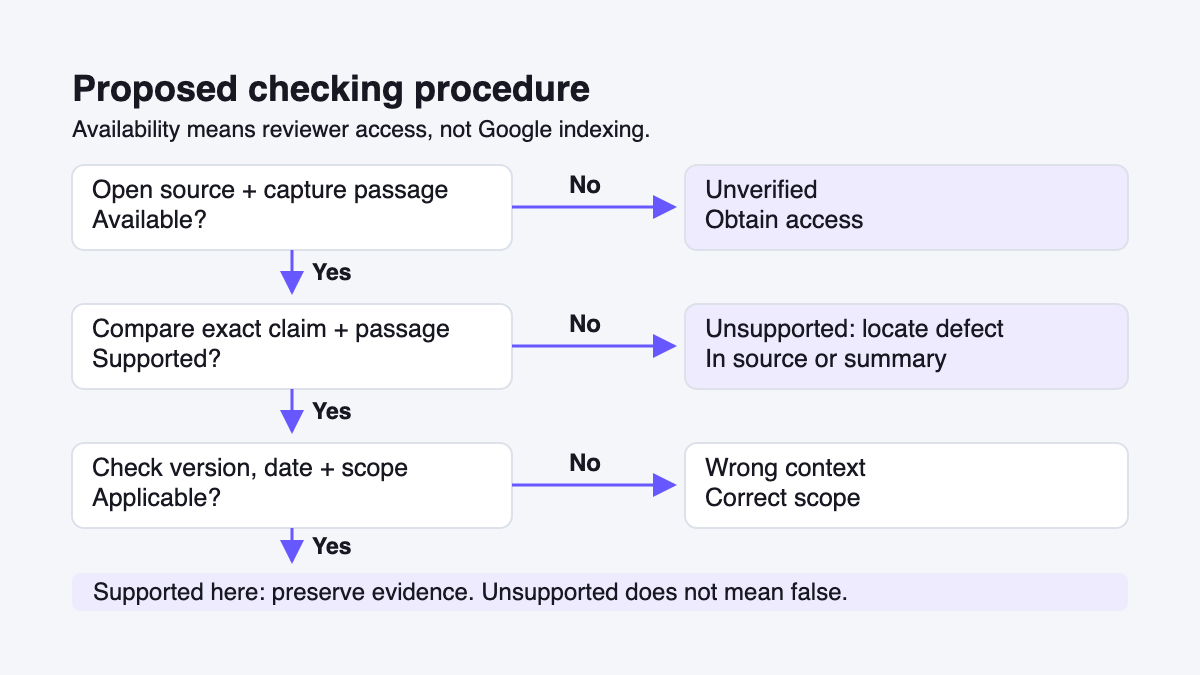
Proposed checking procedure. Missing access leaves the claim unverified; support and applicability need separate checks.
If access fails, stop at “unverified.” If access succeeds but the passage does not support the statement, locate the gap in the source or the answer. If the passage supports the words but not the audience or version at hand, label the scope before deciding what to change. None of those findings alone proves what an external system will do next.
When should you rewrite the source?
Rewrite only when the source itself needs correction. A compact routing matrix keeps that decision tied to what you can inspect. The examples describe conditions to check, not findings from a live engine test.
| Observed defect | Check before acting | Source action | What remains unknown |
|---|---|---|---|
| The cited instruction is false or outdated | Confirm the current wording and effective date with the responsible domain owner | Correct the affected passage and identify the applicable version | Copies or answers that used the earlier wording may persist |
| A sentence has two plausible readings | Point to the phrase and identify the competing interpretations with the domain owner | Clarify the actor, trigger, limit, or exception while preserving verified facts | Whether a particular answer will use the clarified wording |
| The source is accurate but the answer adds an unsupported claim | Compare the exact claim with the passage, including limits and conditions | Keep the accurate source; record the unsupported synthesis and route the answer for review if appropriate | Why the answer added the claim, or whether it will recur |
| The passage applies to another version or scope | Check date, release, audience, region, or stated conditions | Label the relevant version or separate current and archived guidance | Which context an external answer used if it is not visible |
| The cited source cannot be opened | Try an authorized copy or ask the source owner for access | Mark the finding unverified; do not rewrite based on an inaccessible passage | Whether the source supports or contradicts the sentence |
The diagnosis determines the owner. A source defect belongs with the content owner. An accurate passage paired with an unsupported sentence calls for an answer-level correction record, not a source rewrite that would make the documentation less true.
A correct page may still need clarification
The strongest counterargument to “do not rewrite a correct source” is that a technically accurate sentence can still be easy for people to misread. If a phrase has two reasonable interpretations or leaves a necessary scope unstated, clarifying it can help the next human reader as well as make the record easier to inspect.
But an incorrect answer alone does not establish that ambiguity. I would change the source only when a reviewer can point to the unclear phrase or missing condition, then have the domain owner confirm the intended meaning. Preserve the correct fact and its limits. Do not broaden an instruction just to resemble one generated answer, and do not claim a clarification will change an external response.
What should a correction record retain?
For a consequential mismatch, keep enough detail for another reviewer to repeat the check: the prompt and answer as observed, the date and system, the exact cited URL, the relevant passage and source version, the defect you found, the owner, and the next review step. This is a practical editorial recommendation, not a legal retention rule or a provider requirement. For low-stakes brainstorming, a full record may cost more than it helps; prioritize instructions that could materially affect a reader's decision.
Separate observation from interpretation. “The answer says all members can export; the cited paragraph limits export to administrators” is inspectable. “The engine misunderstood our documentation” goes further than the evidence unless the passage, version, and answer have been checked. If the source is private or unavailable, record that limitation rather than marking the claim false. Several copies of one source do not become independent confirmation just because they appear at different URLs.
Can indexing changes guarantee a corrected answer?
No. Google's documentation for AI Overviews and AI Mode says supporting links need an indexed page that is eligible for a Search snippet. It also says that meeting its requirements does not guarantee crawling, indexing, or serving. Those are Google-specific eligibility conditions, not a promise that a page will be selected or that a generated sentence will accurately reflect it.
Keep the terms separate. A reviewer being able to open a page is practical availability. Google indexing and snippet eligibility are technical conditions for those Google features. Neither establishes that the passage supports a claim, and neither guarantees a corrected answer. The cited documentation also says no special AI-specific markup is required. That is not a universal rule for every answer engine; it is Google's guidance for its own features.
When reviewing AI answer engine citation errors, compare one consequential sentence with its cited passage and applicable version, then ask the documentation owner which repair the evidence supports.
Sources
- Nelson F. Liu, Tianyi Zhang, and Percy Liang, “Evaluating Verifiability in Generative Search Engines”, EMNLP Findings 2023. Captured 2026-11-12 UTC.
- NASA, “NASA's Webb Confirms Its First Exoplanet”, published January 11, 2023; page update shown September 21, 2026. Captured 2026-11-12 UTC.
- Google Search Central, “AI features and your website”, publication date not displayed in the inspected excerpt. Captured 2026-11-12 UTC.